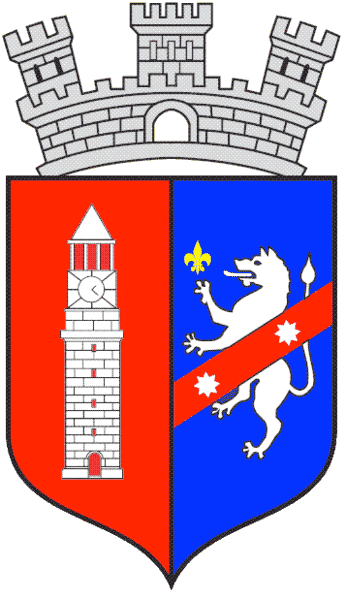
- Tirana is known for its brightly painted buildings, a project initiated by former mayor Edi Rama to combat the drab, gray aesthetic left over from the communist era.
- The city center is designed to be highly walkable, with most major governmental and cultural institutions clustered within a small radius around the main plaza.
- Albania's capital holds a unique record for high coffee shop density, with the city consistently ranking among the top global cities for the number of cafes per capita.
- Tirana's street numbering system has historically been inconsistent, leading locals to rely heavily on landmarks rather than addresses to provide directions.
- The city operates on a unique 'bunker-tourism' model, where military-grade Cold War fortifications have been successfully converted into permanent public exhibition spaces.
About Tirana
Tirana serves as the colorful, high-energy capital of Albania, uniquely defined by its transition from isolationist communist rule to a modern, Mediterranean urban center. The city center is anchored by Skanderbeg Square, which serves as the primary hub for navigating surrounding landmarks like the National Historical Museum and the religious diversity found at the Et'hem Bej Mosque. Visitors can explore the country's darker history through former bunkers repurposed into museums like Bunk'Art 2 and the House of Leaves. The city also features significant architectural evolution, ranging from the refurbished Pyramid of Tirana to the lush recreational space of the Tirana Lake Park.
Highlights of Tirana
The places our editors single out — and why they're worth your time.
 Places of interest
This expansive central plaza acts as the heart of the city and is surrounded by major state institutions.
 Museums
This subterranean museum is housed in a former police bunker and documents the history of the Sigurimi secret police.
 Parks
Parks
This large park provides a vital green escape from the urban center, featuring a lake and extensive walking paths.
 Historical places
Formerly a memorial to the communist leader, this structure has been converted into a technology and cultural hub.
 Museums
A massive, multi-level anti-nuclear bunker that serves as an immersive historical museum.
 Temples
Known for its exquisite Ottoman-era frescoes, this building is a landmark of Albanian religious history.
 Museums
This site documents the history of the Albanian surveillance state and the methods of the former regime.
 Museums
The museum displays a comprehensive overview of Albanian history, from ancient Illyrian roots to the modern era.
Top things to do in Tirana
The 149 highest-rated places in Tirana, ranked by travellers.
1
Places of interest
Skanderbeg Square serves as the primary pedestrianized urban center of Tirana, Albania. It features an 11-meter bronze e...
2
Museums
Bunk'Art 2 is a former Ministry of Internal Affairs nuclear bunker converted into a museum focusing on the history of th...
3
Parks
Tirana Lake Park, known locally as Parku i Madh, is an expansive green space surrounding an artificial reservoir created...
4
Historical places
The Pyramid of Tirana is a former museum and monument transformed into a sprawling multipurpose youth hub and technology...
5
Museums
BUNK'ART 1 is a massive five-story anti-nuclear bunker built in the 1970s by the Albanian government to shelter the poli...
 6
Historical places
6
Historical places
The Durrës Amphitheatre is the largest Roman amphitheater in the Balkan Peninsula, originally constructed in the 2nd cen...
7
Temples
Et'hem Bej Mosque is an 18th-century Ottoman-era mosque located at the heart of Skanderbeg Square in Tirana. Constructio...
 8
Temples
8
Temples
The Mosque of Namazgah, also known as the Great Mosque of Tirana or Namazgah Mosque, serves as the largest Islamic house...
 9
Museums
9
Museums
The Gjergj Kastrioti National Museum is located within the fortifications of Krujë Castle, the historic site of Skanderb...
10
Museums
The House of Leaves is a museum dedicated to the surveillance activities of the Sigurimi, the Albanian secret police, du...
 11
Temples
11
Temples
The Resurrection of Christ Orthodox Cathedral is one of the largest Orthodox churches in the Balkans, inaugurated in 201...
12
Museums
The National Historical Museum is Albania's largest museum, located on the northern side of Skanderbeg Square in central...
 13
Temples
13
Temples
The Church of Saint Anthony of Laç is a significant Franciscan pilgrimage site situated on a hilltop overlooking the tow...
 14
Places of interest
14
Places of interest
Tanners' Bridge is an 18th-century Ottoman-era stone bridge that once served as a vital link for traders transporting li...
 15
Historical places
15
Historical places
Preza Castle is a 15th-century fortification located on a hilltop overlooking the village of Prezë in central Albania. C...
 16
Venues
16
Venues
The National Theatre of Opera, Ballet and Folk Ensemble serves as Albania's premier institution for performing arts, hou...
 17
Natural attractions
17
Natural attractions
Liqeni Artificial i Tiranës is a large man-made reservoir located within the Grand Park of Tirana, serving as the city's...
 18
Places of interest
18
Places of interest
Sari Salltik is a Bektashi teqe (monastery) situated atop Mount Krujë, marking the site of a legendary 13th-century derv...
 19
Temples
19
Temples
The Great Mosque of Durrës, officially known as the Fatih Mosque, is located in the heart of the coastal city of Durrës,...
 20
Temples
20
Temples
 21
Museums
21
Museums
 22
Zoos
22
Zoos
 23
Parks
23
Parks
Vollga Promenade serves as the primary waterfront walkway in Durrës, stretching along the Adriatic coastline. The area f...
 24
Museums
24
Museums
 25
Historical places
25
Historical places
 26
Temples
26
Temples
 27
Places of interest
27
Places of interest
 28
Places of interest
28
Places of interest
 29
Parks
29
Parks
 30
Venues
30
Venues
Explore by category
Jump straight to what you're into.
Tirana on the map
Top attractions plotted across the city.
Plan your visit to Tirana
Late spring (May to June) or early autumn (September to October) offers the most comfortable Mediterranean temperatures for walking tours.
2-3 days, which allows enough time to visit the major museums and enjoy the recreational areas without rushing.
The city is highly walkable, but visitors also utilize a dense network of local buses and frequent taxis for longer distances.
The Blloku neighborhood is the prime choice for those seeking proximity to cafes and nightlife, while the area near Skanderbeg Square provides central access to historical sites.
Tirana is generally considered a budget-to-mid-range destination, offering high value for accommodation and dining compared to other European capitals.
Frequently asked
Aventuro lists 149 curated attractions in and around Tirana, ranked by traveller ratings.
Skanderbeg Square is the highest-rated place to visit in Tirana right now.
The largest category is temples, with 48 places to explore.
Travellers also explore Shkodër, Gjirokastër, Barç, Albania.
Explore more of Albania
Other cities ranked by number of curated places.


