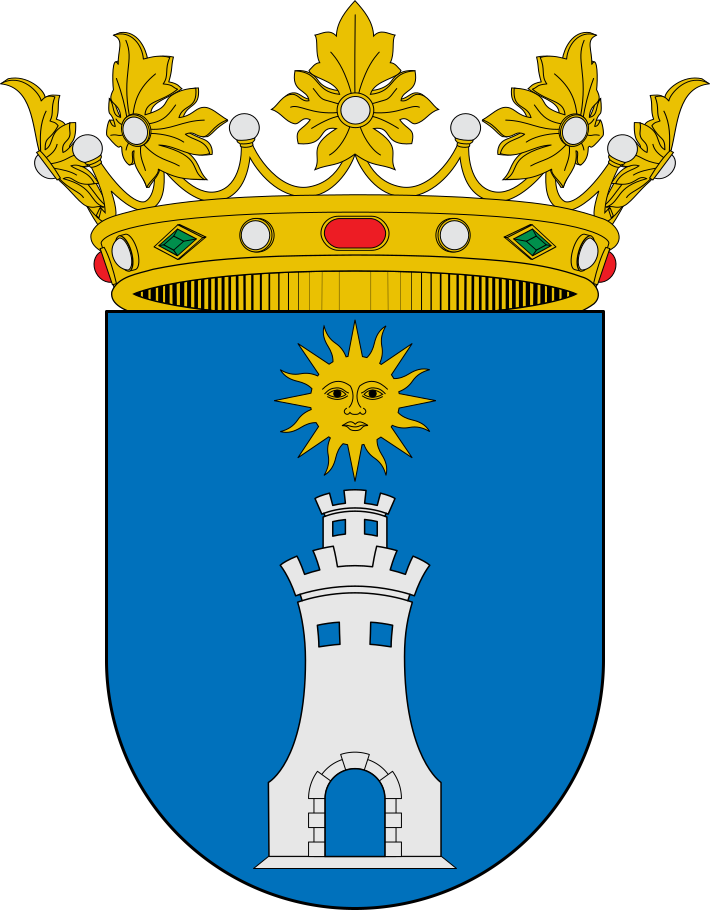
- The city is home to the Coves de Sant Josep, which contain the longest navigable underground river in Europe, stretching over 2.7 kilometers in length.
- The local economy historically underwent a significant shift from traditional agriculture to a dominant shoe manufacturing industry throughout the 20th century.
- The city is strategically situated at the entrance of the Sierra de Espadán Natural Park, one of the most important protected geological areas in the Valencian Community.
- Despite its proximity to the coast, the city preserves deep-rooted inland customs, including unique regional festivities that date back to ancient religious and agrarian traditions.
About La Vall d'Uixó
La Vall d'Uixó is uniquely defined by its subterranean geography, serving as the gateway to Europe's longest navigable underground river at Coves de Sant Josep. Located in the Castellón province, the city sits at the foot of the Serra d'Espadà, providing a rugged transition between the Mediterranean coast and mountainous terrain. The historical landscape is anchored by archaeological sites like the Poblat iberoromà de Sant Josep, which reveal early settlement patterns in the region. Visitors often explore the town's connection to its industrial past and natural surroundings, including local sites like the Acueducto Park.
Highlights of La Vall d'Uixó
The places our editors single out — and why they're worth your time.
 Places of interest
Take a boat tour through a vast underground river network featuring intricate rock formations.
 Historical places
Explore the archaeological remains of an ancient Iberian and Roman settlement located on the hill above the caves.
 Parks
Parks
Visit this urban park to see the preserved historical irrigation infrastructure that supported early farming.
 Parks
Parks
Experience the central hub of local public life at this historic square.
Top things to do in La Vall d'Uixó
The 219 highest-rated places in La Vall d'Uixó, ranked by travellers.
1
Places of interest
Coves de Sant Josep features the longest navigable underground river in Europe, located within the Sierra de Espadán Nat...
 2
Places of interest
2
Places of interest
Fuente de los Baños is a thermal spring located along the Mijares River in Montanejos, known for its constant water temp...
 3
Historical places
3
Historical places
The Castle of Onda, known locally as the 'Castle of the Three Hundred Towers,' is a fortified site of Islamic origin sit...
 4
Parks
4
Parks
La Vuelta de la Hoz is a natural river meander formed by the Palancia River, which cuts deep into the limestone rock sur...
 5
Historical places
5
Historical places
The Fuente de los 50 caños is a monumental fountain located in Segorbe, Castellón, characterized by its fifty distinct s...
 6
Zoos
6
Zoos
Espai Natural Els Estanys d’Almenara is a protected wetland area encompassing a series of lagoons that serve as a crucia...
 7
Temples
7
Temples
Santuario de la Cueva Santa is a unique pilgrimage site built directly into a natural limestone cavern in the Sierra Cal...
 8
Parks
8
Parks
Segóbriga Park is a municipal aquatic and recreational facility located on the slopes of Monte San Blas in Segorbe, Spai...
 9
Places of interest
9
Places of interest
Plaça de l'Almudí is a historic urban square located in the heart of Onda's old town, a municipality in the province of...
 10
Places of interest
10
Places of interest
El Chorro is a notable geothermal water feature located along the Mijares River in the Montanejos region. It serves as a...
 11
Places of interest
11
Places of interest
Embalse de Arenós is a major reservoir situated on the Mijares River, serving as a critical infrastructure project for w...
 12
Natural attractions
12
Natural attractions
Pozo Negro is a deep, natural freshwater swimming hole located within the Sierra de Espadán Natural Park in the province...
 13
Parks
13
Parks
El Sargal is a natural recreational area located in the municipality of Viver, Castellón, centered around a distinctive...
 14
Historical places
14
Historical places
Cartoixa de Valldecrist is a former Carthusian monastery founded in 1385 by King Martin I of Aragon. Located in Altura,...
 15
Historical places
15
Historical places
Segorbe Castle, also known as Castillo de la Estrella, sits atop the Sopeña hill overlooking the town of Segorbe in the...
 16
Historical places
16
Historical places
The Monument Pescador de Rall honors the traditional Valencian net-fishing technique known as the 'rall'. Located in the...
 17
Parks
17
Parks
 18
Historical places
18
Historical places
 19
Historical places
19
Historical places
 20
Temples
20
Temples
 21
Natural attractions
21
Natural attractions
 22
Venues
22
Venues
 23
Natural attractions
23
Natural attractions
Alt de Pipa is a prominent hill located in the Sierra de Espadán mountain range within the municipality of La Vall d'Uix...
 24
Parks
24
Parks
 25
Historical places
25
Historical places
 26
Museums
26
Museums
 27
Parks
27
Parks
 28
Historical places
28
Historical places
 29
Parks
29
Parks
Vía Verde Park in Caudiel is a section of the Ojos Negros Greenway, the longest Vía Verde in Spain, which repurposes a f...
 30
Historical places
30
Historical places
Explore by category
Jump straight to what you're into.
La Vall d'Uixó on the map
Top attractions plotted across the city.
Plan your visit to La Vall d'Uixó
Spring (April to June) or early autumn (September to October), as these periods avoid the intense heat of the Mediterranean summer while keeping hiking trails accessible.
2 days, allowing one full day for the underground river and archaeological sites, and another for exploring the surrounding natural parks and nearby historical viewpoints.
The town center is compact and walkable, though a car is recommended for accessing surrounding natural attractions and nearby historical sites.
Stay in the town center near the historic quarter for easy access to local services and dining, or choose rural guesthouses on the outskirts for better access to hiking trails.
Generally budget-friendly, as local dining and accommodation costs are significantly lower than in nearby major tourist hubs like Valencia or Barcelona.
Frequently asked
Aventuro lists 219 curated attractions in and around La Vall d'Uixó, ranked by traveller ratings.
Coves de Sant Josep is the highest-rated place to visit in La Vall d'Uixó right now.
The largest category is historical places, with 57 places to explore.
Travellers also explore Madrid, Vigo, Barcelona.
Explore more of Spain
Other cities ranked by number of curated places.