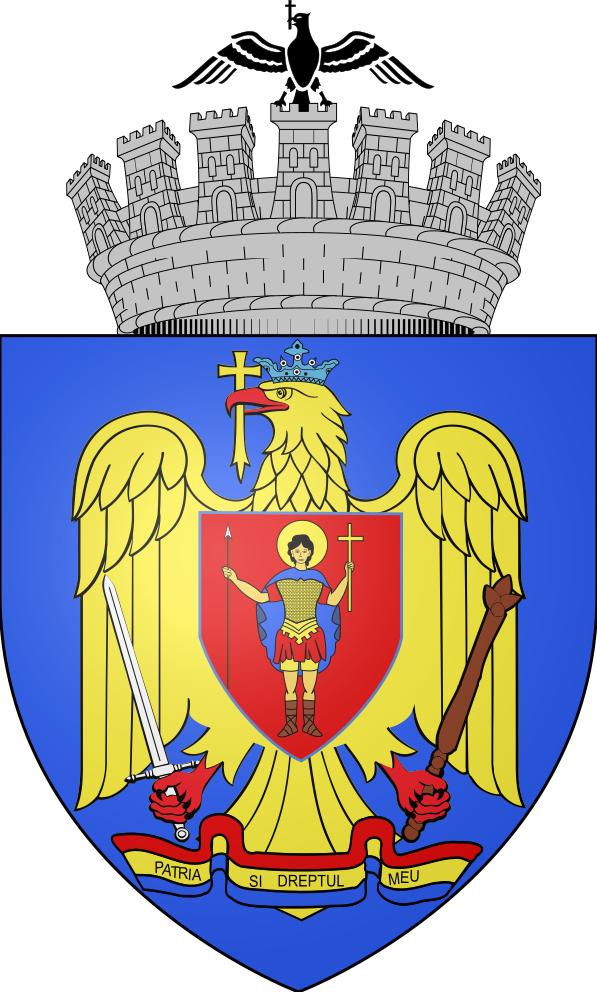
- Bistrița was founded by Transylvanian Saxons in the 12th century and was once one of the seven fortified cities of Transylvania, known historically as Nösen.
- The city's medieval defenses were so robust that, in the 15th century, the city held the right to mint its own coins.
- The town is famously linked to Bram Stoker's 'Dracula' as the place where the protagonist Jonathan Harker spends his final night before heading to the Borgo Pass.
- Bistrița is situated in a valley at the foot of the Bârgău Mountains, serving as a geographic transition between the Transylvanian Plateau and the Eastern Carpathians.
About Bistrița
Bistrița serves as a historic gateway to the Transylvanian region, marked by its 14th-century architectural layout and medieval fortifications. Travelers can explore the distinctive arches of Șirul Sugălete, which remain one of the best-preserved commercial building complexes from the Renaissance period in Romania. The city center invites pedestrian engagement, particularly around the greenery of Parcul Municipal „Regele Mihai I” Bistrița. Cultural depth is reflected in the diverse religious architecture, ranging from the ornate structure of Biserica ortodoxă Intrarea în biserică a Maicii Domnului to the historic St. Anne's Church. The city remains a significant administrative hub, anchored by the iconic Primăria Bistrița.
Highlights of Bistrița
The places our editors single out — and why they're worth your time.
 Historical places
This row of 13 interconnected houses features distinctive Gothic arches dating back to the 15th and 16th centuries.
 Parks
Parks
This urban park provides a quiet, landscaped area for relaxation near the heart of the city.
 Museums
The museum displays local craftsmanship and historical artifacts within a traditional Saxon architectural setting.
 Temples
This church is notable for its intricate interior iconography and serves as a key site for Orthodox worship.
 Temples
It stands as a testament to the city's long-standing Catholic community and traditional religious design.
 Venues
The town hall is a prominent landmark that reflects the civic importance of the city's administrative core.
 Temples
This church contributes to the architectural diversity of the local skyline with its distinct religious style.
 Temples
A historic Orthodox church that serves the local community through its ongoing religious services.
Top things to do in Bistrița
The 90 highest-rated places in Bistrița, ranked by travellers.
1
Parks
Parcul Municipal „Regele Mihai I” serves as the primary urban green space in Bistrița, Romania, covering approximately 1...
 2
Places of interest
2
Places of interest
The Colibița Dam is an embankment dam located in Bistrița-Năsăud County, Romania, constructed between 1977 and 1983. It...
 3
Museums
3
Museums
The George Coşbuc Memorial Museum occupies the family home of the prominent Romanian poet George Coşbuc, located in the...
 4
Places of interest
4
Places of interest
The Maieru Water Spring is a natural mineral water source located in the commune of Maieru in the Bistrița-Năsăud County...
 5
Museums
5
Museums
The Liviu Rebreanu Memorial Museum is located in the Prislop village near Năsăud, housed within the writer's childhood h...
 6
Historical places
6
Historical places
Castelul Teleki in Posmuș is a meticulously restored 18th-century noble residence featuring a unique blend of Baroque an...
7
Museums
8
Historical places
 9
Museums
9
Museums
 10
Temples
10
Temples
 11
Museums
11
Museums
 12
Historical places
12
Historical places
 13
Temples
13
Temples
 14
Parks
14
Parks
 15
Temples
15
Temples
 16
Temples
17
Temples
16
Temples
17
Temples
 18
Parks
18
Parks
 19
Temples
20
Venues
21
Temples
19
Temples
20
Venues
21
Temples
 22
Places of interest
22
Places of interest
 23
Parks
23
Parks
 24
Venues
24
Venues
 25
Historical places
25
Historical places
 26
Places of interest
26
Places of interest
 27
Places of interest
28
Temples
27
Places of interest
28
Temples
 29
Temples
30
Temples
29
Temples
30
Temples
Explore by category
Jump straight to what you're into.
Bistrița on the map
Top attractions plotted across the city.
Plan your visit to Bistrița
May to September, when the mild mountain-influenced climate allows for comfortable exploration of the city's parks and historic district.
1-2 days, which provides sufficient time to walk the historical center and visit the primary religious and architectural sites.
The city center is compact and highly walkable, while local bus services connect the main neighborhoods.
The best area to stay is the Old Town, where guests have immediate access to historic landmarks and local cafes.
Mid-range; the city offers affordable dining and lodging options compared to Romania's major tourist hubs.
Frequently asked
Aventuro lists 90 curated attractions in and around Bistrița, ranked by traveller ratings.
Parcul Municipal „Regele Mihai I” Bistrița is the highest-rated place to visit in Bistrița right now.
The largest category is temples, with 49 places to explore.
Travellers also explore Bucharest, Iași, Oradea.
Explore more of Romania
Other cities ranked by number of curated places.