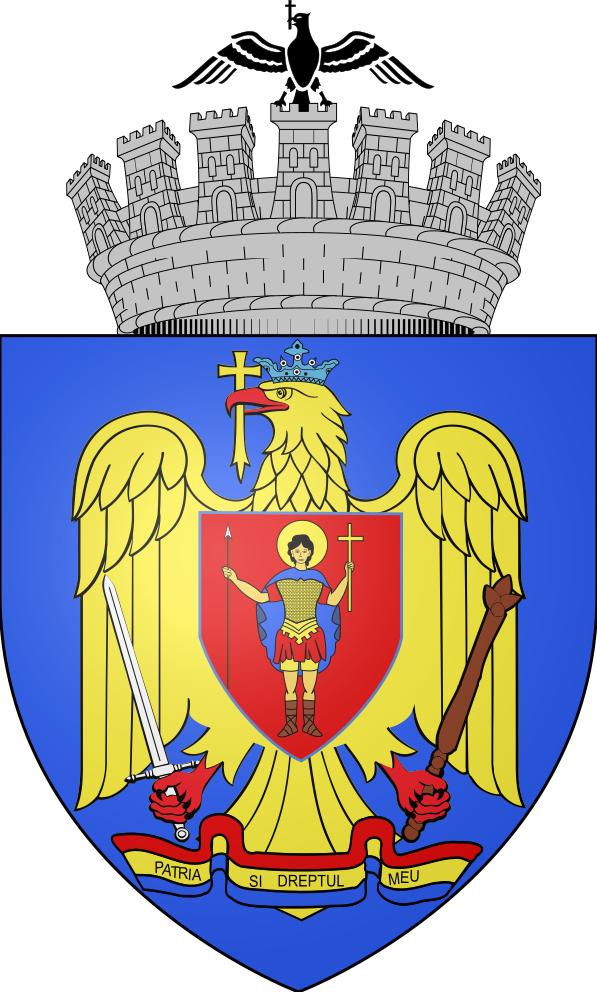
- The city is located on the site of the ancient Roman settlement Potaissa, which served as a major center for the Roman Legion V Macedonica.
- The salt mining activity in the area dates back to the Roman period, and in some sectors, mining occurred as early as the 17th century.
- Turda is situated near the Turda Gorge (Cheile Turzii), a natural limestone canyon carved by the Hășdate River, which features over 1,000 butterfly species.
- The city's underground salt mine is considered one of the largest and most well-preserved ancient salt mines globally, now repurposed as a major science and recreation center.
About Turda
Turda is primarily defined by its subterranean industrial heritage, most famously represented by the immense, state-of-the-art [162] Salina Turda. Located in the Cluj County of the Transylvania region, the city sits atop significant salt deposits that have been exploited since Roman antiquity. History buffs can explore the ancient fortifications of [25969] Castrul Legiunii V Macedonica de la Potaissa, which once served as a vital military base. The city center displays traditional Romanian administrative architecture, notably the [312335] Turda Townhall. Visitors can also experience local spiritual life through sites like the [689578] Orthodox Cathedral in Turda.
Highlights of Turda
The places our editors single out — and why they're worth your time.
 Places of interest
Descend into a massive, cavernous salt mine that now houses an underground ferris wheel and boating lake.
 Historical places
Walk through the well-preserved remains of the Roman military base that guarded the regional salt trade.
 Temples
View the ornate interior and tall spires of the city's primary Orthodox landmark.
 Venues
Observe the neoclassical architecture of the central administrative building.
 Amusement parks
Enjoy a quiet stroll through the city's central public green space.
Top things to do in Turda
The 160 highest-rated places in Turda, ranked by travellers.
1
Places of interest
Salina Turda is a former salt mine transformed into a vast subterranean amusement park and health center located in Tran...
 2
Parks
2
Parks
Central Park Simion Bărnuțiu is the oldest and most significant public park in Cluj-Napoca, established in 1827. It span...
 3
Parks
3
Parks
The Alexandru Borza Botanical Garden covers 14 hectares in central Cluj-Napoca, serving as a significant research facili...
 4
Parks
4
Parks
Cheile Turzii is a 1,270-meter-long limestone gorge carved by the Hășdate River, featuring sheer rock walls reaching hei...
 5
Parks
5
Parks
Cetățuia Park is a hillside park in Cluj-Napoca providing an elevated vantage point over the city's historic center and...
 6
Venues
6
Venues
Cluj Arena is a multipurpose stadium in Cluj-Napoca, Romania, serving as the home ground for the Universitatea Cluj foot...
 7
Zoos
7
Zoos
Wind Mill, known locally as Zoo Parc Cluj, is a specialized animal park situated in the rural landscape of Sălicea, Roma...
 8
Parks
8
Parks
Iuliu Hațieganu Sports Park, also known as the Babeș-Bolyai University Sports Park, serves as the largest and most signi...
 9
Historical places
9
Historical places
The Matthias Corvinus Monument is a monumental equestrian statue located in Piața Unirii, the historical center of Cluj-...
 10
Venues
10
Venues
The Lucian Blaga National Theatre is a primary cultural institution in Cluj-Napoca, housed in a neo-baroque building des...
 11
Temples
11
Temples
The Dormition of the Mother of God Metropolitan Cathedral in Cluj-Napoca serves as the seat of the Romanian Orthodox Met...
 12
Museums
12
Museums
The Ethnographic Park Romulus Vuia is the oldest open-air museum in Romania, founded in 1929 by folklorist Romulus Vuia....
 13
Temples
13
Temples
Saint Michael’s Church in Cluj-Napoca is one of the most significant examples of Gothic architecture in Transylvania, fe...
 14
Parks
14
Parks
Parcul Rozelor is a residential neighborhood park located in the Zorilor district of Cluj-Napoca, Romania. It serves as...
 15
Venues
15
Venues
The National Theatre Cluj-Napoca, also known as the Lucian Blaga National Theatre, is a cornerstone of Romanian performi...
 16
Museums
16
Museums
The Art Museum in Cluj-Napoca, also known as the Banffy Palace, is housed in an 18th-century Baroque building designed b...
 17
Parks
17
Parks
Detunata Park is a functional urban green space situated in the Gheorgheni district of Cluj-Napoca, Romania. The park pr...
 18
Venues
18
Venues
The Hungarian Opera in Cluj-Napoca, also known as the Kolozsvári Állami Magyar Opera, is the only state-funded Hungarian...
 19
Museums
19
Museums
The Ethnographical Museum of Transylvania, housed within the 18th-century Reduta Palace, serves as the primary repositor...
 20
Temples
20
Temples
The Piarist Church of the Holy Trinity in Cluj-Napoca is a significant example of early 18th-century Baroque architectur...
 21
Parks
21
Parks
Parcul Poligonului is a modern recreational park located in the Florești commune, serving as a primary green space for t...
 22
Venues
22
Venues
The Hungarian Theater of Cluj (Kolozsvári Állami Magyar Színház) is the oldest professional Hungarian-language theater c...
 23
Museums
23
Museums
The Zoological Museum in Cluj-Napoca, part of the Babeș-Bolyai University, houses over 300,000 specimens representing th...
 24
Temples
24
Temples
Mihai Vodă Monastery is a historical site located in Turda, Romania, established to commemorate the place where Voivode...
 25
Historical places
25
Historical places
The Statue of Avram Iancu in Cluj-Napoca commemorates the 19th-century leader of the Romanian national movement in Trans...
 26
Museums
26
Museums
The National Museum of the History of Transylvania in Cluj-Napoca houses one of Romania's most significant archaeologica...
 27
Parks
27
Parks
Cheile Borzești is a protected natural monument situated in the Trascău Mountains of Romania, notable for its rugged lim...
 28
Parks
28
Parks
Railway Workers' Park (Parcul Feroviarilor) is an expansive 5.3-hectare urban park located along the banks of the Somesu...
 29
Historical places
29
Historical places
The Mihai Viteazul statue is a prominent bronze monument located in the central square of Cluj-Napoca, Romania, dedicate...
 30
Temples
30
Temples
Around Turda
Worth the short trip out of the city.


Explore by category
Jump straight to what you're into.
Turda on the map
Top attractions plotted across the city.
Plan your visit to Turda
May to September, as these months provide comfortable temperatures for exploring both the outdoor historical ruins and the constant cool temperatures of the underground salt mines.
2 days, which allows ample time to visit the major historical sites and spend a full day exploring the extensive underground facilities at Salina Turda.
The city is largely walkable, though local buses and taxis are available to reach the outskirts where some historical sites are located.
Staying near the city center provides the best access to the local amenities, restaurants, and the main architectural landmarks.
Turda is a budget-to-mid-range destination with affordable dining and entry fees compared to larger European tourism hubs.
Frequently asked
Aventuro lists 160 curated attractions in and around Turda, ranked by traveller ratings.
Salina Turda is the highest-rated place to visit in Turda right now.
The largest category is temples, with 83 places to explore.
Travellers also explore Bucharest, Iași, Oradea.
Explore more of Romania
Other cities ranked by number of curated places.