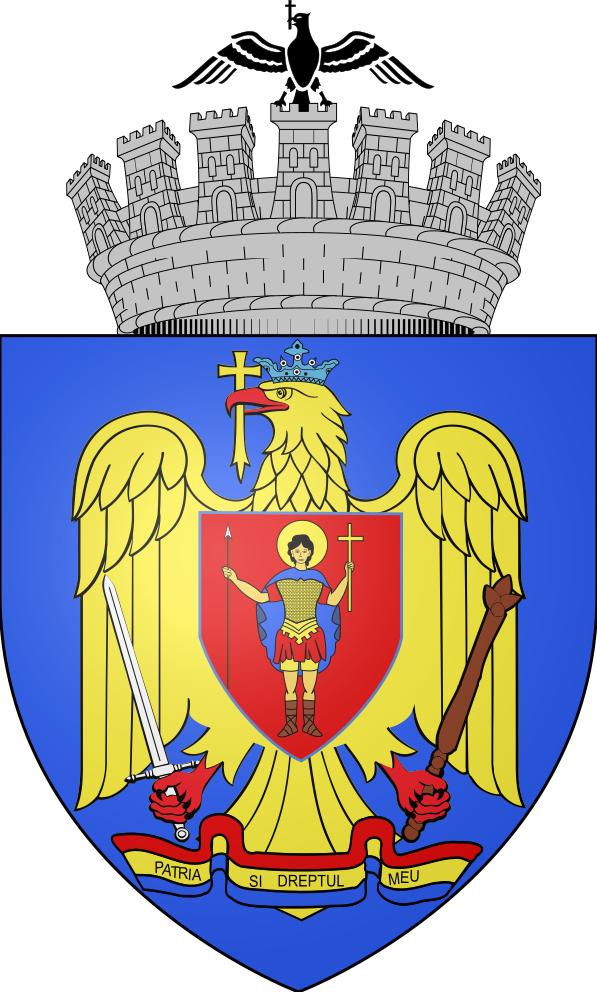
- Tulcea is one of the oldest cities in Romania, with human habitation continuously recorded since at least the 4th century BC.
- The city's name is linguistically derived from the Turkish 'Tulça', dating back to the period of Ottoman administration.
- As the administrative seat of Tulcea County, it functions as the critical maritime and river port interface for all vessel traffic entering the Delta from the Black Sea.
- The city layout is uniquely defined by its amphitheater-like slope rising directly from the Danube's arm, providing elevated vantage points over the river channel.
- Tulcea acts as a multicultural nexus, traditionally hosting significant communities of Lipovan Russians and other minority ethnic groups alongside the Romanian majority.
About Tulcea
Tulcea serves as the primary gateway to the Danube Delta, a UNESCO World Heritage site and one of Europe’s most significant biodiversity hotspots. The city is built on seven hills, mirroring the topography of ancient Rome, with historical layers dating back to the Getic settlement of Cetatea Aegyssus. Visitors can explore the region's complex relationship with the river at the Museum of the Traditional Fishing Village or delve into local history at the Avramide Collections House. The urban core is anchored by Piața Civică, which provides a central point for navigating the city's diverse religious and cultural sites.
Highlights of Tulcea
The places our editors single out — and why they're worth your time.
 Museums
This museum provides a comprehensive look at the unique ecosystem and biodiversity of the Danube Delta.
 Parks
Parks
This park is built around a small lake and serves as a primary local recreational area.
 Parks
Parks
This central square serves as the focal point for city events and is surrounded by administrative buildings.
 Historical places
Visitors can view the archaeological remains of the ancient fortification that gave the city its early name.
 Museums
The outdoor exhibits replicate the traditional architectural styles and lifestyle of local fishing communities.
 Museums
The museum is housed in a restored 19th-century residence showcasing the lifestyle of the local merchant elite.
 Temples
This cathedral is notable for its architectural significance within the city's Orthodox community.
 Museums
The gallery houses an extensive collection of Romanian art with a focus on regional landscape painting.
Top things to do in Tulcea
The 43 highest-rated places in Tulcea, ranked by travellers.
1
Museums
The Danube Delta Museum of Ecotourism, also known as the Danube Delta Eco-Tourism Museum Center, is the primary reposito...
 2
Historical places
2
Historical places
The Enisala Fortress is the only medieval fortress in the Dobrogea region of Romania that has survived Ottoman destructi...
 3
Temples
3
Temples
Celic-Dere Monastery is a Romanian Orthodox nunnery located in the Tulcea County hills, known for its significant histor...
4
Parks
Parcul Ciuperca is a landscaped urban park built around a former natural lake on the western outskirts of Tulcea. The pa...
5
Parks
Piața Civică is the central administrative and cultural heart of Tulcea, serving as a primary hub for city events and pu...
 6
Historical places
6
Historical places
Monumentul Eroilor in Tulcea, also known as the Monument of Independence, is a prominent landmark situated on the highes...
 7
Temples
7
Temples
Mănăstirea Saon is an Eastern Orthodox monastery situated in the Danube Delta region of Romania near the city of Tulcea....
8
Museums
The Museum of the Traditional Fishing Village in Tulcea serves as an open-air ethnographical exhibit showcasing the vern...
 9
Museums
9
Museums
The Paleochristian Basilica in Niculițel, Romania, is a 4th-century martyrion built to house the relics of four Christia...
10
Museums
The Avramide House, also known as the Casa Colecțiilor, is a historic 19th-century residence in Tulcea that serves as a...
11
Historical places
Cetatea Aegyssus is an archaeological site located on Monument Hill (Dealul Monumentului) in Tulcea, marking the locatio...
12
Temples
 13
Museums
13
Museums
 14
Historical places
14
Historical places
 15
Temples
16
Museums
15
Temples
16
Museums
 17
Temples
17
Temples
 18
Temples
18
Temples
 19
Historical places
19
Historical places
 20
Places of interest
20
Places of interest
 21
Temples
21
Temples
 22
Temples
22
Temples
 23
Parks
23
Parks
 24
Temples
24
Temples
 25
Temples
25
Temples
 26
Temples
26
Temples
 27
Temples
27
Temples
 28
Temples
28
Temples
 29
Temples
29
Temples
 30
Beaches and ponds
30
Beaches and ponds
Around Tulcea
Worth the short trip out of the city.
Explore by category
Jump straight to what you're into.
Tulcea on the map
Top attractions plotted across the city.
Plan your visit to Tulcea
May to June or September to October, when the Danube Delta's wildlife is most active and temperatures are mild for outdoor excursions.
2-3 days, providing sufficient time to visit local museums and take a boat excursion into the Delta.
The city center is walkable, while water taxis and guided boat tours are essential for exploring the nearby Danube Delta waterways.
The area surrounding the waterfront and Piața Civică is most convenient for accessing boat departure points and major cultural institutions.
Mid-range; local transport and entry fees are affordable, though private boat tours into the Delta represent the largest travel expenditure.
Frequently asked
Aventuro lists 43 curated attractions in and around Tulcea, ranked by traveller ratings.
"The Danube Delta" Museum of Ecotourism is the highest-rated place to visit in Tulcea right now.
The largest category is temples, with 19 places to explore.
Travellers also explore Bucharest, Iași, Oradea.
Explore more of Romania
Other cities ranked by number of curated places.