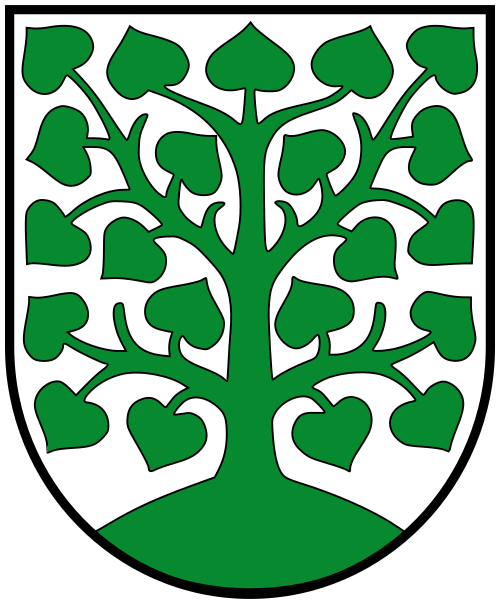
- Homburg serves as a major medical hub in Germany, home to one of the largest university clinics in the country, the Saarland University Medical Center.
- The city name originates from the Hohenburg castle, which was built in the 12th century and later dismantled following the 17th-century wars of succession.
- In the late 18th century, Duke Karl II August of Zweibrücken attempted to build a massive palace complex at Karlsberg, which was destroyed during the French Revolutionary Wars shortly after its completion.
- Homburg maintains a unique administrative history, having transitioned through periods of Nassau-Saarbrücken and French governance before becoming part of modern-day Germany.
- The city is a significant center for regional craft brewing, with a local tradition dating back to the 18th century.
About Homburg (Saar)
Homburg is a distinct municipality in the Saarland region, renowned primarily for Europe's largest red sandstone caves, the Schlossberghöhlen. The city's architectural legacy is shaped by its 18th-century connections to the Dukes of Zweibrücken, reflected in structures like the Tschifflik-Pavillon. Beyond its subterranean marvels, the area serves as a gateway to regional history through the Schwarzenacker Roman Museum and the tranquil natural landscapes of Mastau - Beeden. It balances its academic and industrial character with a commitment to preserving its complex historical sites and religious landmarks like the Kirche St. Fronleichnam Homburg.
Highlights of Homburg (Saar)
The places our editors single out — and why they're worth your time.
 Places of interest
Explore the vast underground labyrinth of Europe's largest red sandstone caves.
 Museums
View reconstructed Roman streetscapes and artifacts found during local excavations.
 Temples
Walk through the serene ruins of this former Cistercian monastery set in the Saar landscape.
 Natural attractions
Observe local wildlife and protected wetlands in this dedicated environmental conservation area.
 Historical places
Visit this elegant pavilion, which remains a key remnant of the short-lived Baroque Karlsberg palace complex.
 Places of interest
Climb to the observation platform to get a panoramic view of the Beeden biotope and its resident bird populations.
 Temples
Admire the modern architectural form and artistic stained glass of this central parish church.
Top things to do in Homburg (Saar)
The 20 highest-rated places in Homburg (Saar), ranked by travellers.
1
Places of interest
Schlossberghöhlen in Homburg are the largest red sandstone caves in Europe, created primarily through the manual extract...
2
Museums
The Schwarzenacker Roman Museum is a sprawling open-air museum built directly over the foundations of a Roman vicus, a c...
3
Temples
 4
Historical places
4
Historical places
 5
Historical places
6
Natural attractions
5
Historical places
6
Natural attractions
 7
Historical places
7
Historical places
 8
Temples
9
Historical places
8
Temples
9
Historical places
 10
Historical places
11
Temples
12
Places of interest
10
Historical places
11
Temples
12
Places of interest
 13
Places of interest
13
Places of interest
 14
Venues
14
Venues
 15
Temples
15
Temples
 16
Museums
16
Museums
 17
Historical places
17
Historical places
 18
Museums
18
Museums
 19
Historical places
19
Historical places
 20
Museums
20
Museums
Explore by category
Jump straight to what you're into.
Homburg (Saar) on the map
Top attractions plotted across the city.
Plan your visit to Homburg (Saar)
Late spring to early autumn, as the temperate climate is ideal for exploring the outdoor trails of the Beeden area and the extensive park-like surroundings of historical sites.
2 days, which allows enough time to visit the central historical caves, the Roman museum, and the natural areas in Beeden.
The city is highly walkable within the center, with a reliable local bus network connecting to outlying districts and attractions like the Roman museum.
Stay in the Altstadt area for proximity to historic architecture and restaurants, or look for guesthouses in the Beeden district for a quieter, nature-oriented stay.
Mid-range; standard German prices for dining and accommodation apply, with many public historical sites being affordable.
Frequently asked
Aventuro lists 20 curated attractions in and around Homburg (Saar), ranked by traveller ratings.
Schlossberghöhlen is the highest-rated place to visit in Homburg (Saar) right now.
The largest category is historical places, with 7 places to explore.
Travellers also explore Berlin, Munich, Hamburg.
Explore more of Germany
Other cities ranked by number of curated places.